
June 25, 2026
Privacy in Memorial Villages often starts with the lot, but it is shaped just as much by city rules, tree protections, and subdivision guidelines. If you are buying, building, or planning a renovation here, it is easy to assume a large lot gives you complete freedom. In reality, each village has its own standards, and those standards can directly affect what you can build, remove, or preserve. This guide will help you understand how lot size, setbacks, trees, and deed restrictions work together in Memorial Villages so you can make a more confident decision. Let’s dive in.
One of the most important things to know is that Memorial Villages is not a single city. The area includes Bunker Hill Village, Hedwig Village, Hilshire Village, Hunters Creek Village, Piney Point Village, and Spring Valley Village.
That matters because each city has its own permit forms, code pages, and review process. Lot size standards, setbacks, tree requirements, and approval steps can vary by municipality and sometimes by subdivision or street.
For you as a buyer, that means two homes in the same broader area may come with very different long-term options. A property that looks similar from the street may have a very different buildable envelope or renovation path once you review the details.
When buyers talk about privacy, they often focus on square footage of the home or how far the house sits from neighbors. In Memorial Villages, the actual lot size is often the first factor that sets those limits.
A larger lot can give you more breathing room, but the raw lot area is only part of the story. You also need to know whether the lot is conforming, how much of it can be covered, and how setbacks reduce the usable building area.
Bunker Hill Village states that District A lots must be at least 20,000 square feet. The city also caps impermeable building area at 45 percent of the lot and total lot coverage at 55 percent.
That means the size of the lot does not automatically translate into unlimited expansion. Hard surfaces and building footprint both matter when you evaluate how much room you truly have.
Hunters Creek Village treats lots of 22,500 square feet or larger as conforming lots. Its checklist also states a 75-foot minimum width at the front building line, a 120-foot minimum depth, and 25 percent buildable area for conforming lots.
For nonconforming lots, the checklist allows a smaller buildable area based on the lesser of 33 percent of lot area or 5,625 square feet. This can have a major impact if you are considering a remodel, addition, or new construction plan.
Spring Valley Village says residential lots must have at least 10,000 square feet of lot area and at least 120 feet of depth. Its residential packet also notes that lot coverage should not exceed 50 percent of lot area in front of the required building line and 60 percent behind it.
This creates a different planning framework than some of the larger-lot villages. If you are comparing options across Memorial Villages, it helps to look beyond the list price and ask how the lot rules affect your future flexibility.
Piney Point Village caps main-structure lot coverage at 30 percent and total lot coverage at 50 percent. Even on a large lot, those percentages can shape the scale and siting of a house, driveway, patio, and other hardscape.
If privacy is a top goal, these standards can be part of the reason many properties feel more open and buffered. The rules can limit how much of the site becomes built space.
Hedwig Village requires a land survey verifying setbacks, limits total lot coverage to 40 percent, and caps building height at 35 feet. For buyers, that means both horizontal and vertical limits can affect how a property evolves over time.
If you are planning to purchase with future updates in mind, these details deserve early review. They can influence not just design but also the cost and timing of approvals.
Setbacks are one of the clearest reasons Memorial Villages homes often feel spacious and private. These rules determine how close a house can sit to the front, sides, and rear of a lot.
They also vary significantly by city. In some cases, they even change depending on the right-of-way width, street type, or lot condition.
Hunters Creek Village shows a 50-foot front setback, side setbacks of 20 feet and 35 feet with one side at least 15 feet, and a 25-foot rear setback. These dimensions can create meaningful separation between neighboring homes.
For a buyer, that spacing can preserve privacy and visual openness. At the same time, it can limit how far an addition or replacement home can extend.
Spring Valley Village uses a more variable approach. Front setbacks are 25 feet on 60-foot rights-of-way, 30 feet on 50-foot rights-of-way, and 20 feet on cul-de-sacs.
The city also lists 8-foot side setbacks by default, with larger setbacks in certain cases, plus rear setbacks of 10 feet for the first floor and 25 feet for the second floor. That second-floor rear setback is especially important if you are evaluating the massing potential of a two-story plan.
Piney Point Village generally requires front yards of 50 feet, though some streets allow 40 feet or 25 feet. Side yards are generally 15 percent of lot width, but never less than 15 feet or more than 30 feet, with certain streets set at 10 feet, and rear yards are generally 20 feet deep.
This is a good example of why buyers should verify the exact street-specific rule instead of relying on a broad summary. The details can meaningfully change what feels possible on paper.
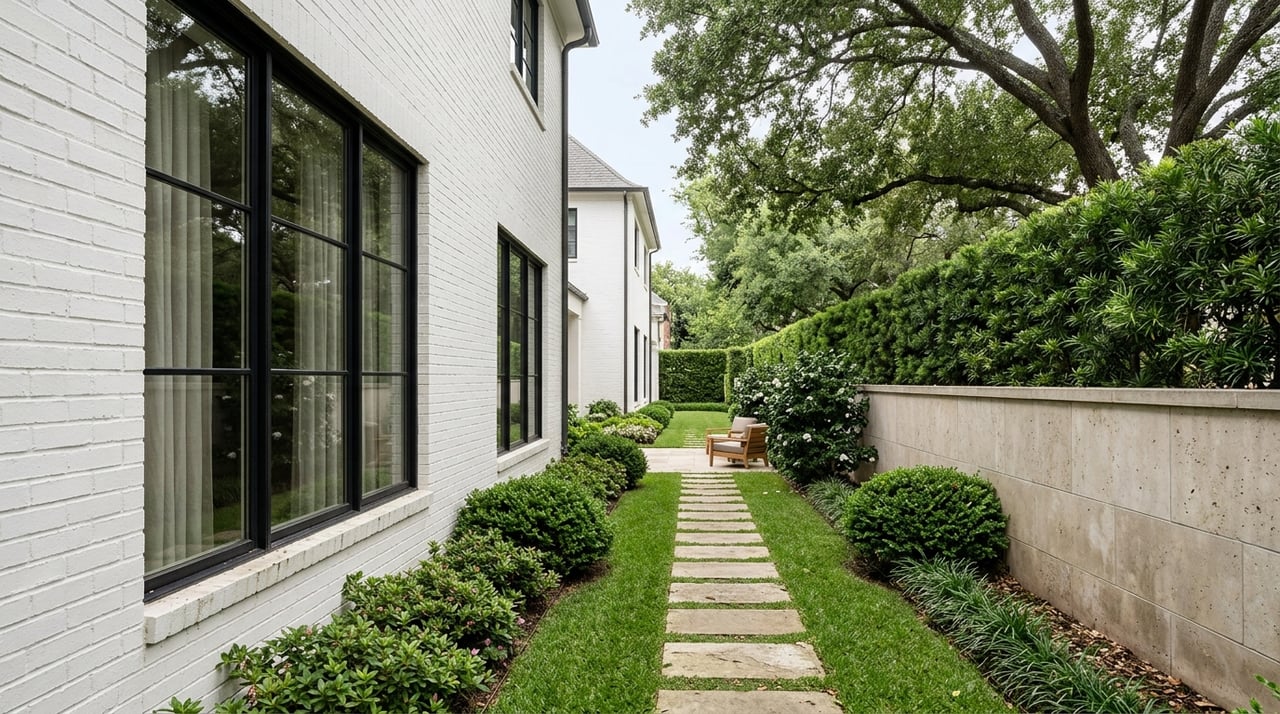
In Memorial Villages, mature trees are often part of what makes a property feel sheltered and established. They can soften views, create screening, and add a sense of separation that fencing alone cannot provide.
But trees are not just a visual feature. In several villages, they are regulated closely, and that can affect what happens after closing.
Bunker Hill Village says trees under 5 inches in diameter may be removed without a permit. Its current tree-removal form also states that the remaining trees on a lot must meet a minimum density of 1 tree per 1,000 square feet of lot area.
So if you are hoping to clear a lot extensively, the existing tree pattern matters. A landscape plan may need to work around density requirements rather than start from scratch.
Piney Point Village states that a live tree 3 inches or greater in diameter, measured 4 feet 5 inches above grade, requires a removal permit. Its tree-disposition guidance says replacement trees must meet a minimum density of one tree per 2,000 square feet of lot area, with at least 25 percent of the replacement trees within 20 feet of the perimeter.
For buyers seeking privacy, this can be a meaningful advantage because perimeter trees help preserve screening. For buyers planning major site work, it is a reminder that tree removal and replacement are part of the planning equation.
Hunters Creek regulates tree removal and construction-site tree protection and requires tree surveys and tree-disposition or protection plans for permits. Spring Valley requires a tree survey and tree-disposition plan before permit issuance, including for residential accessory structures.
Hedwig Village also requires a tree-disposition plan and a tree survey from a degreed forester. In practical terms, mature canopy can be a privacy asset, but it may also limit how easily you can clear, regrade, or redesign the site.
City approval is only one part of the picture in Memorial Villages. Many subdivisions also have deed restrictions or architectural review requirements that apply separately from city permits.
Hunters Creek Village makes this especially clear in its new-building materials. The city notes that many subdivisions have deed restrictions affecting size, appearance, placement, and other project details, and that the city does not review plans for deed-restriction compliance.
That means a project can require both municipal approval and separate subdivision or HOA approval. If you are buying with renovation plans in mind, that second layer is just as important as zoning.
Tynewood, a deed-restricted subdivision within Piney Point Village, offers a useful example of how detailed these private standards can be. Its published requirements include a stamped survey, a 50-foot front setback, 20-foot side setbacks, a two-story maximum, and rules that prohibit street-facing garages or porte-coches with gates.
The same document states that no air-conditioning equipment, pool equipment, or generators may be placed in setbacks, and no walls, hedges, fences, or gates are allowed in front or side setbacks. It also requires HOA approval for new fences or gates and says only officially stamped, dated, and initialed plans indicate approval.
This kind of overlay can strongly affect privacy design, exterior appearance, and future improvements. It is one reason due diligence in Memorial Villages needs to go beyond the survey and city checklist alone.
If you want privacy today and flexibility tomorrow, ask focused questions early. A little upfront review can help you avoid expensive surprises later.
Here are some of the most important items to confirm before closing:
Spring Valley says new single-family homes require Planning and Zoning chairman sign-off before a permit is issued. Hunters Creek requires a pre-construction meeting before plan submittal or at the time of submittal.
Privacy in Memorial Villages usually comes from a mix of larger lots, preserved trees, and rules that limit how close, tall, or visually open new construction can be. The exact balance depends on the village, the lot, and often the subdivision.
That is why a thoughtful home search here is about more than finding the right square footage or style. You are also evaluating how the property can function for you now and what it may allow later.
Whether you are relocating, searching for a long-term family home, or comparing tear-down versus move-in-ready options, it helps to have a clear read on the rules before you commit. A well-chosen property in Memorial Villages can offer both beauty and breathing room, but the details truly matter.
If you are exploring Memorial Villages and want a more curated, property-specific perspective, Lynn Tohme can help you evaluate lot potential, privacy considerations, and the approval layers that may shape your decision.
Stay up to date on the latest real estate trends.


My multicultural background allows me to cater to the varied needs of my local and international clients, ensuring that each transaction is a carefully crafted experience that respects and celebrates cultural diversity.
1800 St James Place Ste 302 Houston TX 77056