
August 27, 2026
Pull up two listing sites for University Place on the same afternoon and you will get two different neighborhoods. One tracker, reading data from January 2026, put the median sale price at $1.25 million, up sharply from the year before, with homes selling in an average of 38 days and prices ranging from $729,000 to $4.2 million. Another, reading more recent data this summer, showed the average price at $784,000, down 22.9 percent year over year, with homes sitting for 74 days, nearly double the 42-day average across greater Houston in June 2026.
Neither number is wrong. They are measuring two different markets that happen to share a name.
University Place is not a single subdivision with a homeowners' association and a matching architectural style. It is the City of Houston's Super Neighborhood 28, a designation that traces back to the University Place Association's founding in 1989. In 2000, the area became the first Super Neighborhood the city ever formalized, a model Houston later applied across dozens of other communities.
That single administrative name covers six distinct civic subdivisions: Southampton, Boulevard Oaks, Morningside Place, Old Braeswood, Southampton Extension, and Southgate. Add in Rice University's campus, the Rice Village retail corridor, and the businesses along Holcombe Boulevard, and you have a footprint where a 1932 bungalow on a live-oak block can sit four lots from a home finished last October. The broader housing stock in the area, including condos, spans construction dates from 1922 to 2022, a full century of building styles inside the same civic boundary.
When a market is this compressed geographically but this stretched out architecturally, a single median tells you almost nothing about what you would actually pay for a specific kind of home on a specific kind of street.
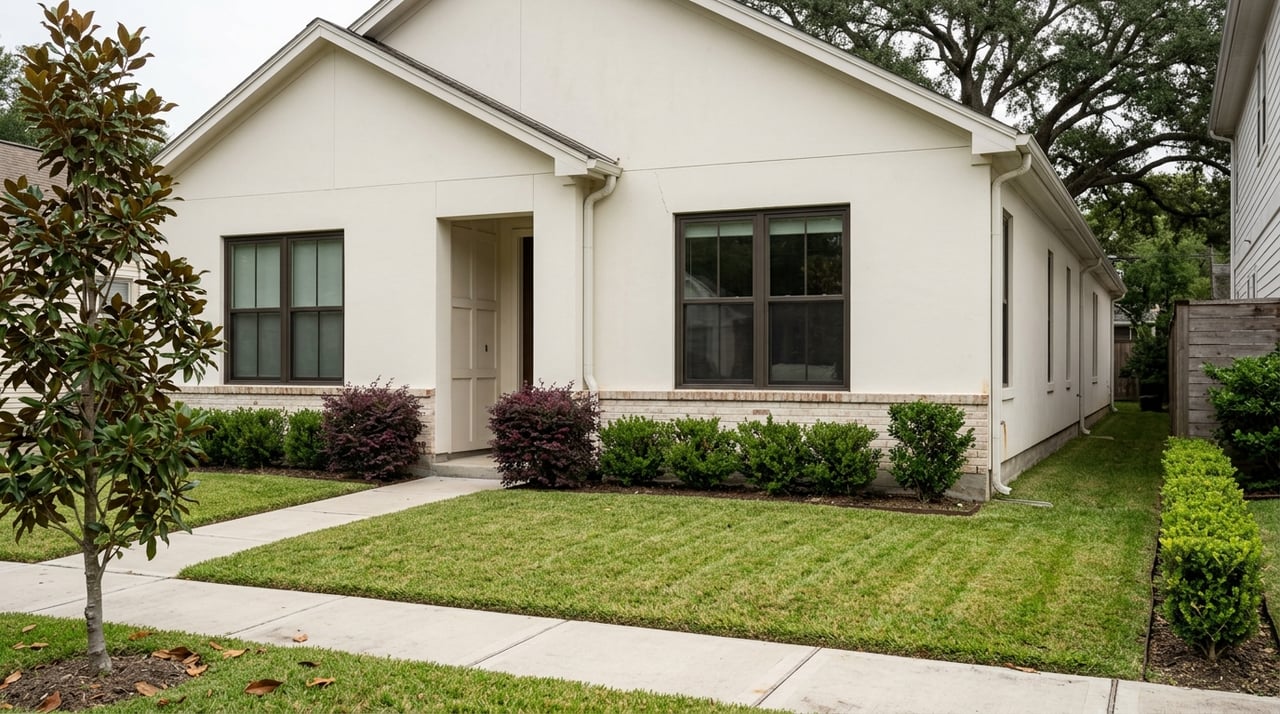
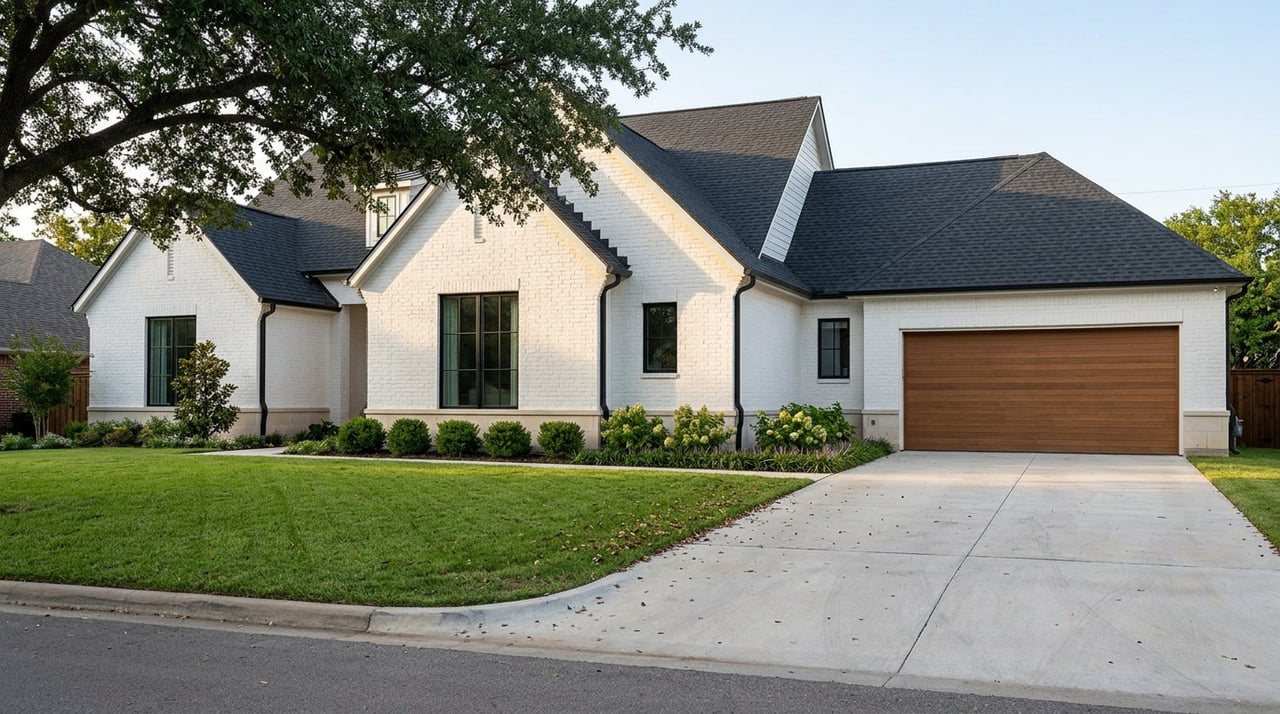
Walk Boulevard Oaks or Southampton right now and the bifurcation is visible from the sidewalk. Builders including Mazzarino Construction & Development and Wood Custom Homes have been going lot by lot, replacing original 1930s and 1940s houses with five and six bedroom homes finished in the past year, some over 5,000 square feet. One recent Croix Custom Homes build changed hands again just seven months after its first owner moved in, listed below the original purchase price, a small but telling sign of how quickly new construction turns over here compared to the century-old homes around it.
That is the mechanism behind the price spread. A month where more original bungalows close pulls the average down. A month where more finished custom builds close pulls it up. Because University Place is a small enough market that a handful of closings can swing the numbers, whichever data source happens to catch a construction-heavy month will report a very different neighborhood than one that catches a renovation-heavy month. Neither is measuring a trend. Both are measuring a sample.
There is a second force at work, and it opened in spring 2026. The Langley is a 20-story, 134-unit apartment tower at 1717 Bissonnet, built by StreetLights Residential for owner Hunt Companies on the site of the Ashby high-rise, a project that drew one of the biggest land-use fights in Houston's history after it was first proposed in 2007. After years of opposition and a redesign, the project broke ground in 2023 and opened this past spring.
As of June 2026, average asking rent at the Langley stood at $14,113 a month, the highest average asking rent of any apartment tower in the city, according to Houston Chronicle reporting that cited CoStar data. The least expensive unit was running about $9,480 a month, with the priciest advertised unit, a 3,396 square foot residence, asking $19,235 a month. Pricing on the building's eight penthouses had not yet been released at that time.
The building's own leasing team has said the strongest early interest is coming from homeowners already living in West University and Southampton, along with relocating professionals moving from out of state. That detail matters more than it looks. The Langley is not competing for renters who were never going to buy. It is competing for the exact households, empty nesters in large, older homes, who would otherwise have listed those homes for sale. Every one of them who chooses a lease instead of a listing is a house that never enters the resale pool, which means fewer of the older, larger-lot comps that would normally balance out the new construction closings.
Fewer sellers on one side of the ledger, more high-priced new construction on the other. That combination is enough to make monthly price data swing without any real shift in what a typical home here is worth.
If you are cross-shopping University Place against other close-in Houston neighborhoods, the single most useful thing you can do is stop comparing at the neighborhood level and start comparing at the subdivision and vintage level. A renovated 1940s home in Southampton and a newly finished custom build in Boulevard Oaks are not two data points on the same curve. They are two different products that happen to share a mail carrier.
For sellers, this cuts both ways. An older home on a deep lot in Old Braeswood or Southgate is not competing against the $4 million new construction closings pulling the average upward. It is competing against buyers who want exactly that lot, that canopy, and that price point, some of whom are builders. Knowing which buyer pool you are actually in changes how you price and how you market.
For buyers, it means asking a more specific question than "what's the median in University Place." Ask what a comparable home, same subdivision, same construction era, same lot size, sold for in the last few months. In a market this compressed, that is the only median that means anything.
For context, the broader Houston market these six subdivisions sit inside was in a notably different place in July 2026: active single-family listings hit a record 40,750, up 3.4 percent year over year, while the citywide median price edged up just 0.6 percent to $340,000, according to the Houston Association of Realtors' July 2026 housing update. University Place's volatility is not a citywide story. It is a small, architecturally split market getting measured with tools built for larger, more uniform ones.
Is University Place the same as West University Place? No, and the names cause real confusion. University Place is Houston's Super Neighborhood 28, an unincorporated area covering Southampton, Boulevard Oaks, Morningside Place, Old Braeswood, Southampton Extension, and Southgate. West University Place is a separate, independently incorporated city west of Kirby Drive with its own municipal government. They border each other but are governed, and priced, differently.
Will the Langley affect home values in Southampton and Boulevard Oaks? It is too early to draw a firm conclusion, since the building only opened this past spring. What is already visible is that its leasing team is drawing directly from the pool of nearby homeowners considering a move, which thins the supply of the kind of older, larger homes that typically anchor comparable sales in this area.
What should I actually look at instead of the median price? Subdivision, construction vintage, and lot size, in that order. A meaningful comparison in University Place means matching a home to others of a similar age and footprint within the same civic subdivision, not averaging across a footprint that spans a century of construction.
If you are trying to make sense of a neighborhood where the data itself is telling two stories, that is exactly the kind of read a founder-led advisor is built for. Lynn Tohme and the team at Loulou Estates Group track these subdivision-level patterns across Houston's inner loop every day. Schedule a consultation to talk through what a specific block, lot, or listing in University Place is actually worth right now.
Stay up to date on the latest real estate trends.
My multicultural background allows me to cater to the varied needs of my local and international clients, ensuring that each transaction is a carefully crafted experience that respects and celebrates cultural diversity.
1800 St James Place Ste 302 Houston TX 77056